In the world of industrial separation, the agitated thin film evaporator (ATFE) stands out as a powerful tool. This advanced evaporation technology provides an effective solution for concentrating and purifying liquids, especially those that are viscous or sensitive to heat. By enabling highly efficient heat transfer in a compact design, the ATFE has become essential for a wide range of applications. This article will guide you through how this impressive piece of equipment works and why it is so important.
Table of contents
- Key Highlights
- Understanding the Agitated Thin Film Evaporator (ATFE)
- Core Working Principle of ATFE
- Main Components and Design Aspects of ATFE
- How Agitation Enhances Evaporation Efficiency
- Real-World Applications in India and Key Industries
- Advantages and Limitations of ATFE Technology
- Maintenance and Operational Practices in ATFE
- Frequently Asked Questions
- Conclusion
Key Highlights
- An agitated thin film evaporator (ATFE) excels in industrial processes by offering efficient and rapid evaporation.
- It operates by spreading liquid into a thin film on a heated surface, which significantly boosts heat transfer.
- The system uses mechanical agitation to create turbulence, preventing fouling and ensuring uniform processing.
- One of its key benefits is a very short residence time, making it ideal for heat-sensitive materials.
- ATFEs can handle a wide range of viscous and difficult-to-process fluids with high efficiency.
Understanding the Agitated Thin Film Evaporator (ATFE)
At its core, an agitated thin film evaporator, also known as a wiped film evaporator, is a device designed for rapid and gentle evaporation. It consists of a cylindrical vessel with a heated wall and an internal rotating assembly. The feed liquid is spread into a very thin layer against this heated surface.
This thin film allows for incredibly fast evaporation of volatile components. The system’s unique design makes it a superior choice for processing materials that are difficult to handle in traditional evaporators. Let’s look closer at its specific features and working process.
Basic Definition and Concept of ATFE
An agitated thin film evaporator is a specialized type of evaporator that uses mechanical agitation to create and refresh a thin liquid film. This process occurs on the inner surface of a heated cylindrical body. The primary goal is to maximize the heat transfer area and accelerate the rate of evaporation.
Unlike pool boiling evaporators where liquid sits in a large volume, the ATFE, or wiped film evaporator, ensures the entire product is exposed to the heated surface for a very brief period. The rotor continuously spreads the liquid, ensuring that no part of it overheats.
This concept is crucial for separating volatile components from less volatile ones efficiently. By creating a turbulent film on the surface of the heated wall, the ATFE achieves superior performance, especially under vacuum conditions which lower the boiling point of the liquid. This makes it ideal for delicate and high-value products.
Unique Features Compared to Other Evaporators
What sets an agitated thin film evaporator apart from other evaporation systems? The key difference lies in its dynamic approach to creating the evaporating surface. Instead of relying on gravity or natural circulation, it uses high-speed rotor blades to actively manage the liquid film.
This mechanical agitation offers several distinct advantages over falling film or forced circulation evaporators. The constant wiping action prevents fouling and ensures that even highly viscous materials flow smoothly. This feature allows the ATFE to handle a wide range of challenging products that would clog other systems.
Key distinguishing features include:
- Short residence time: The product is exposed to heat for only a few seconds, preventing thermal degradation.
- Mechanical agitation: The rotor system creates a turbulent, thin film, maximizing heat transfer efficiency.
- High vacuum capability: It can operate at very low pressures, allowing for distillation of high-boiling materials at lower temperatures.
Core Working Principle of ATFE
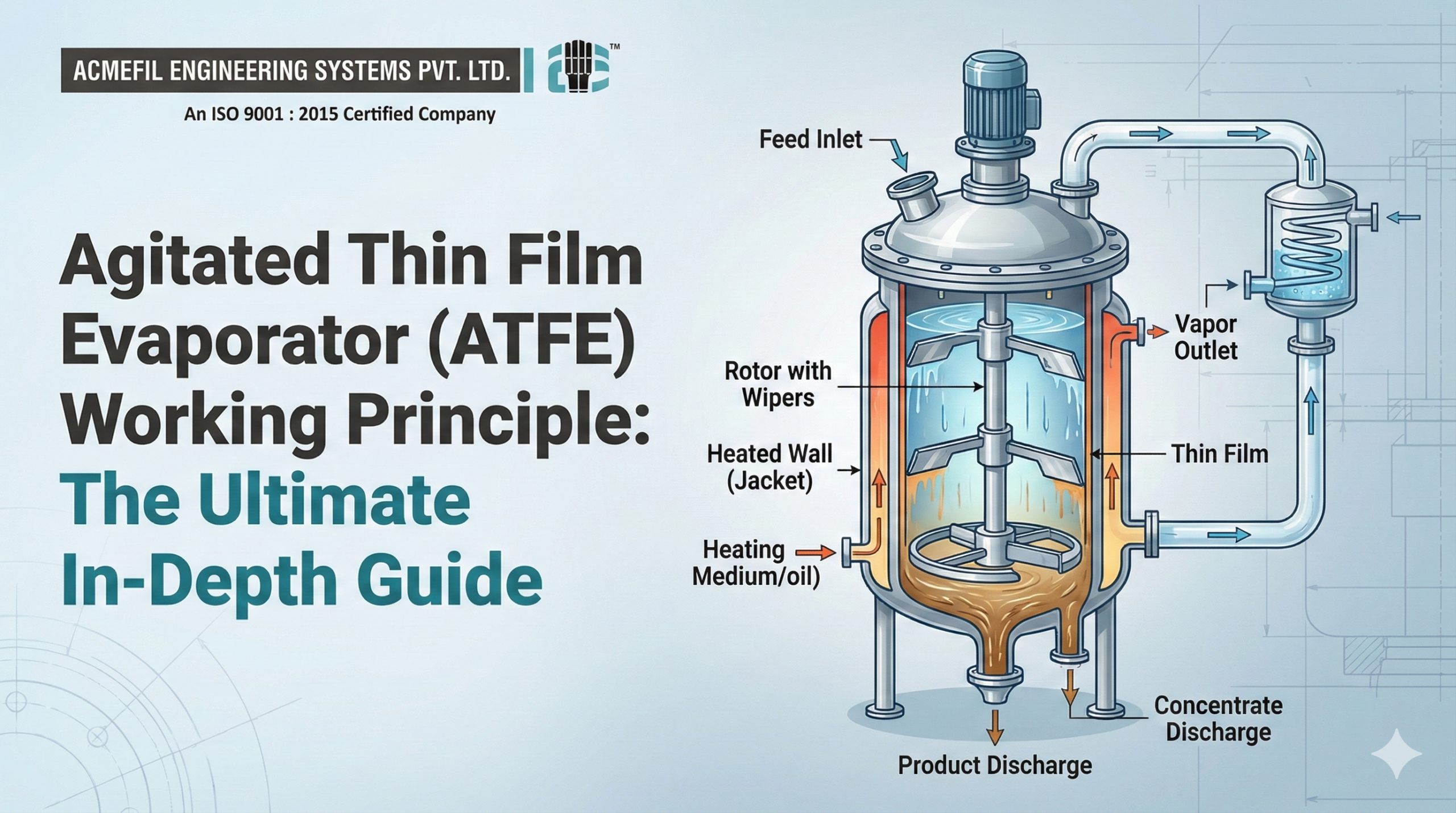
The core working principle of an ATFE is simple yet highly effective. It revolves around creating the perfect conditions for rapid evaporation. The liquid feed enters the evaporator and is immediately spread into a thin, turbulent film on a heated surface by a set of rotating blades.
This thin film provides a massive surface area for efficient heat transfer and mass transfer to occur. Heat moves from the jacketed wall into the liquid, causing the volatile solvent to turn into vapor almost instantly. This vapor is then separated and collected, leaving behind a concentrated product.
Formation and Role of the Thin Film
The formation of a thin liquid film is the most critical aspect of the ATFE’s operation. When the feed liquid is introduced, the distributor ensures it is spread evenly around the circumference of the evaporator’s inner wall. The rotor blades then get to work, smearing this liquid into a film that can be less than a millimeter thick.
This thin film formation dramatically increases the surface area available for heat transfer. In a wiped film evaporator, every part of the liquid is in close contact with the heated wall, eliminating the temperature gradients found in bulk liquids. This ensures that heat is transferred quickly and uniformly throughout the product.
Furthermore, the high speed of the rotor creates a turbulent film. This turbulence constantly renews the surface of the film, bringing fresh liquid to the heated wall and helping vapors escape easily. This intense mixing enhances the evaporation rate far beyond what is possible in static systems.
Step-by-Step Evaporation Process in ATFE
The evaporation process in an ATFE can be broken down into a few clear steps, all happening in a continuous, single pass. First, the feed liquid is precisely introduced at the top of the unit.
From there, the journey to a concentrated or dried product is very quick. The high-speed rotor immediately distributes the liquid onto the heated internal wall. As the material flows down, the agitation enhances evaporation by creating intense turbulence, which maximizes heat transfer and helps release vapor molecules from the liquid. Operating under a high vacuum lowers the boiling point, making the process even more efficient.
The entire journey is completed in seconds:
- Vapors generated rise and exit through a vapor outlet for condensation and solvent recovery.
- The non-volatile, concentrated liquid or dried product continues to the bottom of the unit.
- The final product is continuously discharged, making the ATFE ideal for uninterrupted industrial production.
Main Components and Design Aspects of ATFE
An agitated thin film evaporator is engineered with several key components that work together to achieve efficient separation. The main structure is a cylindrical heated body, which provides the heat transfer surface. Inside this body is the heart of the system: the rotor assembly.
This assembly is equipped with wiper blades that are precisely positioned close to the heated wall. As the rotor spins, these blades distribute the feed liquid and create the all-important thin film. We will now explore the design of these components and how they contribute to the ATFE’s performance.
Rotor, Blades, and Agitation Mechanism
The rotor assembly is the dynamic core of the ATFE. It consists of a central shaft fitted with multiple rows of rotor blades. This assembly is designed to rotate at a very high speed, driving the entire agitation mechanism.
The design of the rotor blades is critical for performance. They can be rigid, hinged, or have other specialized shapes depending on the application and the viscosity of the material being processed. As they spin, the blades maintain a small, precise clearance from the heated wall, spreading the liquid into a uniform film.
This continuous agitation is what makes the ATFE so effective. The mechanical action generates intense turbulence in the liquid film, preventing the formation of stagnant layers and ensuring that heat is rapidly distributed. This process also mechanically pushes the concentrated product down the evaporator, ensuring a smooth and consistent flow.
Heat Transfer Surface and Material Choices
The heat transfer surface of an ATFE is the inner wall of the cylindrical body, which is enclosed by a heating jacket. This heated wall is where the evaporation takes place. For efficient heat transfer, this surface must be smooth, uniform, and made from a material with excellent thermal conductivity.
The choice of material for the evaporator is crucial and depends on the product being processed. Factors like corrosiveness, temperature requirements, and industry standards (e.g., pharmaceutical or food-grade) dictate the material choices. Stainless steel is common, but more corrosive applications may require exotic alloys.
Selecting the right material ensures the longevity of the equipment and prevents contamination of the final product. The surface of the wall is carefully engineered to work with the rotor blades to create optimal film conditions.
| Material | Key Properties | Common Applications |
|---|---|---|
| Stainless Steel | Good corrosion resistance, cost-effective, hygienic | Food, pharmaceutical, chemicals |
| Hastelloy | Excellent resistance to highly corrosive chemicals | Aggressive acids, fine chemicals |
| Titanium | High strength-to-weight ratio, superior corrosion resistance | Saline solutions, specific chemicals |
How Agitation Enhances Evaporation Efficiency
Agitation is the key to the ATFE’s superior performance. The mechanical action of the rotor blades creates a turbulent flow within the thin liquid film. This turbulence dramatically increases the rate of heat transfer from the heated wall into the liquid, leading to more efficient evaporation.
By constantly renewing the film on the heat transfer surface, agitation prevents the buildup of insulating layers and ensures that the entire product is uniformly heated. This process, combined with operation under vacuum to achieve a lower boiling point, results in exceptionally high heat transfer coefficients and rapid processing times.
Distribution of Feed and Prevention of Fouling
Proper distribution of feed liquid is the first step toward efficient operation. An ATFE uses a specially designed distributor at the top of the unit to spread the incoming liquid evenly around the inner circumference of the evaporator. This ensures that the rotor blades receive a consistent supply of material to create a uniform film.
One of the greatest challenges in evaporation is fouling, where deposits build up on the heated surface and reduce efficiency. The mechanical agitation in an ATFE is highly effective at the prevention of fouling. The continuous wiping action of the blades scrubs the wall, preventing solids from sticking and hardening.
This self-cleaning mechanism delivers several benefits:
- Maintains high heat transfer rates over long periods.
- Reduces the need for frequent shutdowns for cleaning.
- Allows for the processing of materials that are prone to scaling and fouling, ensuring rapid evaporation without interruption.
Handling Heat-Sensitive and Viscous Materials
Yes, agitated thin film evaporators are exceptionally well-suited for handling both heat-sensitive materials and viscous materials. Their design directly addresses the challenges these products pose. For heat-sensitive products, the key advantage is the extremely short residence time. The material is exposed to the heating surface for only a matter of seconds.
This brief exposure minimizes the risk of thermal degradation, preserving the product quality, color, and activity of delicate compounds like pharmaceuticals, food extracts, and vitamins. The ability to operate under a deep vacuum further protects these materials by allowing evaporation to occur at much lower temperatures.
For viscous materials, the powerful mechanical agitation is the solution. The rotor blades physically move the thick liquid down the heated wall, preventing it from sticking and ensuring it flows smoothly through the system. This allows the ATFE to process materials with viscosities up to 20 million cP, which would be impossible in other evaporator types.
Real-World Applications in India and Key Industries
The versatility of the agitated thin film evaporator makes it a vital component in a wide range of industrial processes across India and the world. Its ability to gently and efficiently handle difficult materials makes it invaluable in sectors where product quality is paramount.
Industries such as the chemical industry, pharmaceutical industry, and food processing rely on ATFEs for concentration, purification, and solvent recovery. The following sections will explore some of these specific applications and explain why the ATFE is the preferred evaporation technology in these fields.
Use in Chemical, Pharmaceutical, and Food Industries
In the chemical industry, ATFEs are used for concentrating acids, purifying monomers, and stripping solvents from residues. Their ability to handle corrosive and viscous materials, combined with high heat transfer rates, makes them ideal for improving yields and purifying final products.
The pharmaceutical industry depends on ATFEs for processing active pharmaceutical ingredients (APIs) and other sensitive products. Applications include concentrating extracts, solvent recovery from reaction mixtures, and drying slurries under vacuum. The gentle processing ensures that the potency and purity of these high-value compounds are maintained.
Similarly, in food industries, ATFEs are used to concentrate fruit juices, milk products, and plant extracts without damaging their flavor, color, or nutritional value. The short residence time is perfect for these heat-sensitive products, delivering high-quality concentrates that meet consumer expectations.
Role of ATFE in Wastewater Treatment and Zero Liquid Discharge (ZLD)
Agitated thin film evaporators play a crucial role in modern wastewater treatment, particularly in achieving Zero Liquid Discharge (ZLD). ZLD systems aim to eliminate liquid waste streams by recovering clean water and concentrating dissolved solids for disposal or reuse.
In these systems, the ATFE is often the final stage of evaporation technology. It takes the highly concentrated brine from earlier stages and further reduces its volume. The ATFE’s ability to handle high-viscosity slurries and prevent scaling makes it perfect for concentrating the effluent to a solid or semi-solid concentrated product.
This process is vital for managing industrial wastewater that contains high boiling point contaminants or materials that would foul traditional evaporators. By turning liquid waste into a manageable solid cake, the ATFE helps industries comply with environmental regulations and recover valuable water.
Advantages and Limitations of ATFE Technology
ATFE technology offers significant benefits for many industrial applications, primarily due to its efficient heat transfer and ability to protect product quality. Its high-speed operation and compact design make it a powerful tool for continuous processing. The system excels at handling viscous, fouling, and heat-sensitive materials.
However, it is also important to recognize its limitations. The mechanical complexity and higher initial cost can be a drawback compared to simpler evaporators. The following sections will provide a detailed look at both the major benefits and the potential considerations you should be aware of.
Major Benefits for Industrial Processes
The primary benefit of using an ATFE is its ability to deliver efficient evaporation while protecting sensitive products. The combination of a thin film, high turbulence, and vacuum operation results in very high heat transfer coefficients, meaning the process is fast and effective.
This technology is designed for continuous operation, making it perfect for large-scale industrial production where consistency and throughput are key. Its vertical orientation and compact design also mean it requires less floor space than many other types of evaporators with similar capacity.
Here are some of the major benefits:
- Superior handling of sensitive products: Short residence time and the ability to achieve a lower boiling point prevent thermal degradation.
- High efficiency: The agitated thin film leads to exceptionally high heat transfer rates.
- Reduced fouling: The self-cleaning action of the wiper blades minimizes maintenance downtime and ensures consistent performance.
Considerations and Potential Drawbacks
While highly effective, there are some considerations to keep in mind when choosing an ATFE. The primary drawback is often the initial cost, which can be higher than that of simpler evaporation systems due to its precise engineering and moving parts.
The mechanical complexity of the rotor and drive system also means that maintenance can be more intensive compared to static evaporators. Seals and bearings require routine inspection and replacement to ensure reliable, long-term operation and to maintain the high vacuum necessary for the process.
Additionally, while ideal for many applications, the ATFE may not be the best choice for all materials. Abrasive solids in the feed can cause wear on the rotor blades and the heated wall. Careful evaluation of your specific process requirements, including feed characteristics and desired final product form, is essential before investing in this technology.
Maintenance and Operational Practices in ATFE
To ensure the long-term operation and optimal performance of an agitated thin film evaporator, consistent maintenance practices are essential. Proper routine care not only extends the life of the equipment but also maintains its high operational efficiency and protects product quality.
Key aspects of maintenance include regular inspections, adherence to recommended cleaning procedures, and monitoring the condition of critical components like the rotor and seals. In the next sections, we will discuss specific cleaning methods and best practices to keep your ATFE running smoothly.
Routine Care and Cleaning Procedures
Effective cleaning procedures are fundamental to the routine maintenance of an ATFE. Although the system is designed to minimize fouling, some product residue can build up over time, especially during product changeovers. A well-planned Cleaning-In-Place (CIP) protocol is often used.
This typically involves circulating cleaning solvents or solutions through the unit to dissolve any remaining product. The rotor assembly can be run at a low speed during this process to help dislodge stubborn deposits from the heated surface. The choice of cleaning agent will depend on the product that was processed.
Key routine maintenance tasks include:
- Regularly inspecting the wiper blades for wear and ensuring proper clearance.
- Checking the seals on the rotor assembly to prevent vacuum leaks or product contamination.
- Lubricating bearings according to the manufacturer’s schedule to ensure smooth rotation. Following these steps helps maximize the operational life of the equipment.
Best Practices for Long-Term Efficiency
Achieving long-term efficiency from your ATFE goes beyond basic maintenance. It requires adopting a set of best practices for operation. This starts with ensuring the feed liquid is properly pre-treated to remove any abrasive particles that could damage the internal components.
Consistent monitoring of operating parameters such as temperature, pressure, and motor load is also crucial. Any sudden changes can indicate a problem, such as a failing bearing or a vacuum leak, allowing you to address it before it causes a major shutdown. Keeping a detailed log of performance and maintenance activities helps in tracking trends and optimizing the process over time.
Ultimately, a proactive approach is key. By combining regular, thorough maintenance with smart operational strategies, you can ensure your ATFE delivers reliable, continuous operation, efficient heat transfer, and consistent product quality for years to come.
Frequently Asked Questions
Can Agitated Thin Film Evaporators handle difficult feeds or viscous material?
Yes, ATFEs are specifically designed for viscous materials. The mechanical action of the rotor blades ensures that even thick liquids are spread effectively for efficient heat transfer and rapid evaporation. The short residence time also protects product quality, making them ideal for challenging feeds that other systems cannot handle.
What makes ATFE different from other evaporation systems?
The primary difference is its mechanical agitation mechanism. Unlike other evaporation technology that relies on gravity or circulation, an ATFE uses rotating blades to create a thin, turbulent film. This increases the surface area for evaporation, provides a very short residence time, and actively prevents fouling on the heat transfer surface.
What are the key points to consider when selecting an ATFE for a new application?
When selecting an ATFE, consider the properties of your feed liquid, such as viscosity and fouling tendency. It’s also vital to evaluate your requirements for final product quality, especially for heat-sensitive materials. Finally, assess the required capacity to determine the necessary heat transfer area and overall unit size.
What are the main components of an Agitated Thin Film Evaporator (ATFE)?
The main components of an ATFE, or wiped film evaporator, include a jacketed cylindrical vessel that serves as the heated wall, a rotor assembly fitted with rotor blades, a feed distributor, a vapor outlet, and a product outlet. The rotor is the key component that creates the thin film.
How does the agitating mechanism enhance the evaporation process in an ATFE?
The agitation mechanism, driven by the rotor assembly, creates a turbulent film on the heated surface. This action maximizes heat transfer, constantly renews the liquid layer, and prevents fouling. This leads to highly efficient evaporation, even with difficult-to-process materials, ensuring a faster and more uniform process.
What are some common applications for Agitated Thin Film Evaporators in various industries?
Common applications include concentration and purification in the chemical industry, processing of sensitive APIs in the pharmaceutical industry, and creating fruit juice concentrates in food processing. They are also critical for solvent recovery and are increasingly used in wastewater treatment for Zero Liquid Discharge (ZLD) systems.
Conclusion
In conclusion, the Agitated Thin Film Evaporator (ATFE) presents a revolutionary approach to efficient evaporation across various industries. Its unique design and agitation mechanism significantly enhance the evaporation process, making it an ideal solution for handling heat-sensitive and viscous materials. The advantages of ATFE technology, coupled with its applications in sectors such as pharmaceuticals, chemicals, and food production, highlight its importance in modern industrial processes. However, understanding its limitations and maintenance practices is crucial for optimal performance. If you have any questions or need assistance regarding the implementation of ATFE technology in your operations, get in touch with us for expert guidance.